


MARKET OVERVIEW
U.S. stocks lost ground as investors grew more skeptical that the artificial intelligence boom could deliver profits quickly enough to justify its mounting costs. Technology shares bore the brunt of the pullback, leaving the Nasdaq behind the broader market while the Dow proved more resilient. The pressure peaked on October 30, when the Nasdaq dropped 2.9% and the S&P 500 lost 1.8%. The late-month retreat reflected rising scrutiny of capital spending and cash flow, as elevated expectations overshadowed otherwise strong earnings across much of the market.
Earnings highlighted that divide. With 299 S&P 500 companies having reported, 82% exceeded analysts’ profit estimates, yet investors reacted sharply to disappointing forecasts and rising investment requirements. Technology results brought greater scrutiny of how large data center projects would be financed and when they would generate attractive returns. Energy companies benefited from a different backdrop: higher prices and stronger refining margins helped support quarterly profits. Continued disruption to shipping through the Strait of Hormuz kept energy supply risks in focus, underscoring how the conflict with Iran could support producers while adding costs for businesses and households.
Economic reports reinforced the tension between resilient growth and persistent inflation. Real Gross Domestic Product (GDP) expanded at a 3.4% annualized rate in the third quarter, up from 2.2% in the second quarter, supported by investment and consumer spending. September’s Personal Consumption Expenditures (PCE) Price Index rose 0.5% for the month and 3.6% for the 12 months ended September, compared with 3.4% in August. Inflation-adjusted consumer spending was essentially flat in September, suggesting less momentum entering the fourth quarter.
The Federal Reserve held its benchmark interest rate at 3.75%-4.00% on October 28, but two policymakers favored a quarter-point increase. That disagreement underscored the challenge of containing inflation while sustaining economic growth. Resilient growth and persistent inflation left markets balancing economic momentum against the prospect of interest rates remaining elevated for longer.
Advisor Perspective
Heading into November, our outlook remains neutral as improving economic indicators are offset by renewed market volatility and growing questions about corporate spending. Third-quarter growth remained solid, and corporate profits have generally exceeded expectations. At the same time, investors are examining whether the significant capital being committed to artificial intelligence can generate sufficient returns. Consumer spending has also remained resilient, but declining savings leave households with less flexibility if income growth weakens. These competing signals support a patient approach as we assess how the economy and markets respond to these pressures.
The economic data is moving in a better direction. Economic activity, production, and service conditions improved during October, while financial system stress eased. Third-quarter economic growth accelerated, supported by business investment and consumer spending. However, the improvement has not been uniform. Employment and broader economic conditions remain weaker areas, and some global leading indicators lost momentum. The recent progress is encouraging, but we would like to see it become more consistent across the labor market and other economically sensitive areas before adopting a more optimistic outlook.
Consumers remain an important part of that assessment. Household spending has not slowed meaningfully despite elevated borrowing costs and persistent inflation. However, consumers are saving a smaller share of their income. This does not necessarily indicate that spending is about to decline, but it reduces the cushion available to absorb higher expenses or a disruption in earnings. Continued income growth becomes increasingly important when households rely more heavily on current earnings to maintain their spending. This deserves attention while employment conditions remain mixed.
Corporate earnings provide another source of support. With a majority of S&P 500 companies reporting third-quarter results by the end of October, more than 80% exceeded earnings expectations. Strong profits help explain why the market has held up despite an uneven economic backdrop. However, investors have become less willing to reward earnings without a clear path for future returns.
That scrutiny has been especially visible among large technology companies investing heavily in artificial intelligence and data center infrastructure. Many remain highly profitable, but the scale of their spending has raised questions about debt issuance, capital requirements, and free cash flow. Negative free cash flow does not automatically mean that a business is weakening, particularly when the company is deliberately investing in future capacity. Still, it increases the importance of those investments eventually producing sufficient revenue and profits. Investors are beginning to distinguish more clearly between companies funding growth from a position of financial strength and those taking on greater balance sheet risk without a proven return.
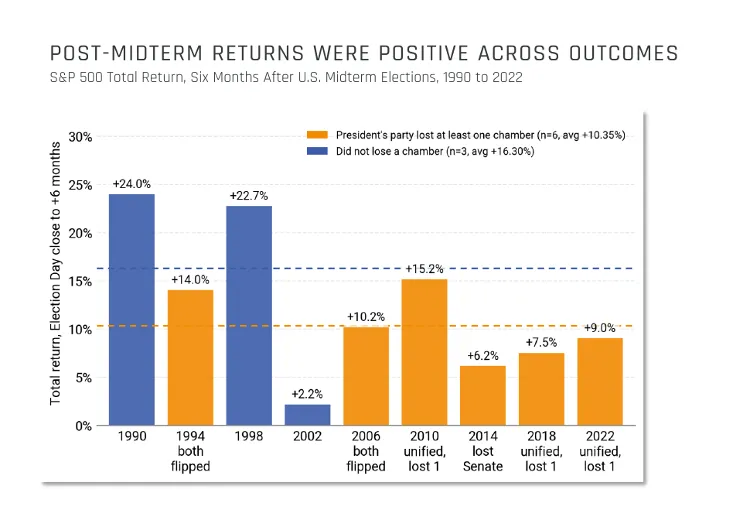
Midterm elections can create uncertainty as investors consider how potential policy changes may affect the economic and market outlook. As shown in the chart below, the S&P 500 produced positive returns in each of the six-month periods following the midterm elections included, although results varied considerably. This pattern should not be treated as a forecast, but it provides useful context that favorable market outcomes have occurred under a range of political circumstances. Over the long term, economic growth, corporate earnings, inflation, and interest rates are likely to have a greater influence on market performance than any single election outcome.
Interest rates remain another source of uncertainty. The Federal Reserve held rates steady in October, but persistent inflation and disagreement among policymakers left open the possibility that rates could remain elevated or move higher. Treasury yields offer meaningful income opportunities, but higher rates also increase financing costs for consumers and businesses. This adds another reason to monitor companies relying heavily on debt to fund expansion.
The current environment calls for discipline. Economic conditions have improved and corporate profits remain supportive, but declining household savings, uneven employment conditions, and questions surrounding large corporate spending programs warrant caution. We believe the appropriate approach is to remain invested while emphasizing quality, financial flexibility, and careful risk management as the evidence develops.
DISCLOSURE
This update is not intended to be relied upon as forecast, research, or investment advice, and is not a recommendation, offer, or solicitation to buy or sell any securities or to adopt any investment opinions expressed are as of the date noted and may change as subsequent conditions vary. The information and opinions contained in this letter are derived from proprietary and nonproprietary sources deemed by Hilltop Wealth & Tax Solutions (“Hilltop Wealth”) to be reliable. The letter may contain “forward-looking” information that is not purely historical in nature. Such information may include, among other things, projections, and forecasts. There is no guarantee that any forecast made will materialize. Additional information about Hilltop Wealth is available in its current disclosure documents, Form ADV, Form ADV Part 2A Brochure, and Client Relationship Summary Report, which are accessible online via the SEC’s Investment Adviser Public Disclosure (IAPD) database at www.adviserinfo.sec.gov/firm/summary/290981. Hilltop Wealth is not an attorney, and no portion of this content should be interpreted as legal advice. Hilltop Wealth may refer clients to its tax division for tax preparation and/or bookkeeping services. Services will be separately agreed upon between the client and the tax division and bill the client separately for services.