


MARKET OVERVIEW
The bond market, more than the stock market, set the tone as August drew to a close. A summer selloff in long-dated government debt intensified in mid-August, pushing the 30-year Treasury yield to its highest level since 2007 while borrowing costs across Germany, France, Japan and the United Kingdom climbed to or near multi-year highs. Persistent fiscal deficits, above-target inflation, renewed oil pressure and heavy debt issuance all contributed to concerns about demand for long-duration bonds. The Treasury Department responded by unexpectedly doubling planned buybacks of longer-dated securities, briefly calming yields, while Federal Reserve Chair Kevin Warsh used his first Jackson Hole address as chair to reinforce that inflation remains the Fed’s primary concern and that another rate hike is firmly in play. Equities absorbed those pressures relatively well, although leadership beneath the surface shifted.
Rate-sensitive areas felt much of the pressure. Utilities and real estate lagged as higher yields reduced the appeal of dividend-paying shares, while small caps lost momentum late in the month as borrowing-cost concerns returned. Technology recovered from midmonth weakness after strong semiconductor earnings reinforced the durability of AI spending, helping the sector finish August as one of the market’s stronger performers. Retail earnings offered a more cautious view of the consumer. Walmart reported sales growth but warned that gasoline above $4 a gallon was forcing shoppers to make trade-offs, echoing broader signs that households are prioritizing essentials and value. Gold surged above $4,600 an ounce to a more than three-month high before falling sharply as yields rebounded, the dollar strengthened, and expectations for another Fed rate hike increased.
The economic data did little to settle the policy debate. The Personal Consumption Expenditures (PCE) price index rose 0.2% in July and 3.7% from a year earlier, slightly above forecasts, while core PCE, which excludes food and energy, matched expectations at 3.3%. The second estimate of second-quarter gross domestic product held at a 1.5% annualized pace, down from 2.1% in the first quarter, although consumer spending was revised higher. Meanwhile, the Conference Board’s Consumer Confidence Index slipped to 89.4 from 90.2 as expectations for the next six months deteriorated. Warsh called the inflation picture concerning and deliberately avoided offering forward guidance at Jackson Hole, leaving traders at month-end pricing roughly a two-thirds chance of a quarter-point rate increase at the Fed’s September meeting.
Bottom line: August ended with equities higher but the backdrop less comfortable than the headline return suggests. The S&P 500 gained about 2.6% for the month even though it finished roughly 1.4% below its August 13 record close, while renewed U.S.-Iran hostilities pushed oil back above $90 a barrel and added another source of inflation pressure. The August employment report on September 4 and Consumer Price Index on September 11 now carry added weight ahead of the Fed’s September 15-16 meeting. A weaker labor market would argue for patience, while persistent inflation and elevated energy prices strengthen the case for another hike. Equities have so far absorbed that tension, but September will test how long that resilience can continue if growth and inflation keep pulling policy in opposite directions.
Advisor Perspective
Heading into September, the market backdrop remains cautiously constructive, even as the economy continues to send mixed signals. Economic growth remains soft, labor conditions have cooled, and higher interest rates remain a constraint. However, corporate profits continue to provide meaningful support for equity markets, while forward-looking economic indicators suggest that the expansion has not yet broken down. The environment may not be great, but it has remained good enough to support markets and justify a patient, wait-and-see approach.
Recent economic data continues to point toward a softer economy rather than an outright contraction. Employment, production, and broader measures of economic activity remain weak, but consumer sentiment and sales have improved modestly. Forward-looking indicators have also been somewhat more encouraging, with measures of global output and leading economic activity holding up better than many of the more immediate data points. Taken together, the economy appears to be moving at a slower pace, but the weakness has not become broad or severe enough to signal that a recession is imminent.
The labor market remains one of the most closely watched areas of the economy, particularly after recent employment reports showed slower job growth and meaningful downward revisions to prior estimates. While those figures deserve attention, the underlying environment may not be as concerning as the headlines suggest. Unemployment remains relatively low by historical standards, but layoffs have not increased materially, and initial unemployment claims have generally remained contained.
Instead, the labor market is increasingly being characterized as a low-hire, low-fire environment. Businesses have become more cautious about adding employees, but they have also shown little urgency to reduce their existing workforces. This dynamic can create softer payroll growth without necessarily signaling a sharp deterioration in employment. The risk is that prolonged weakness in hiring could eventually weigh on income growth and consumer spending. For now, however, limited layoffs continue to provide an important source of stability.
Corporate earnings have also helped offset concerns surrounding the economy. Companies continue to generate profits, maintain healthy margins, and exceed expectations at a rate that has provided a durable foundation for equity markets. Artificial intelligence and technology-related investment remain important contributors, but earnings strength has also extended into other areas of the market. This has allowed equities to remain resilient despite higher bond yields, persistent inflation, and uncertainty surrounding monetary policy.
Market participation has also remained relatively healthy. Although rising yields created some pressure during August, particularly for rate-sensitive areas, broader market breadth has held up, and the equal-weighted S&P 500 has continued to perform well. This suggests that market strength is not solely dependent on a small group of the largest technology companies. Broader participation does not eliminate the risk of volatility, but it improves the underlying foundation of the market and provides some reassurance that investors are still finding opportunities across different sectors and investment styles.
Interest rates remain one of the most important variables shaping the outlook. Long-term Treasury yields increased during August as investors considered persistent inflation, heavy government borrowing, and the possibility that monetary policy could remain restrictive for longer than previously anticipated. At the same time, markets continue to price in some degree of eventual easing as economic activity and employment soften. The timing of any rate cut remains uncertain and will depend heavily on whether inflation continues to moderate. This leaves the Federal Reserve balancing two competing risks: maintaining restrictive policy for too long as growth slows or easing too quickly while inflation remains above target.
Higher yields have created near-term pressure across both stocks and bonds, but they have also improved the longer-term return potential of fixed income. As the accompanying chart illustrates, the Bloomberg U.S. Aggregate Bond Index produced a positive return over the following 12 months in 14 of the 17 periods since 2003 when the 10-year Treasury yield had risen by at least 50 basis points over six months and the S&P 500 remained near its high. More importantly, every period that began with an aggregate bond yield above 4% produced a positive subsequent 12-month return, with a median gain of 6.1%.
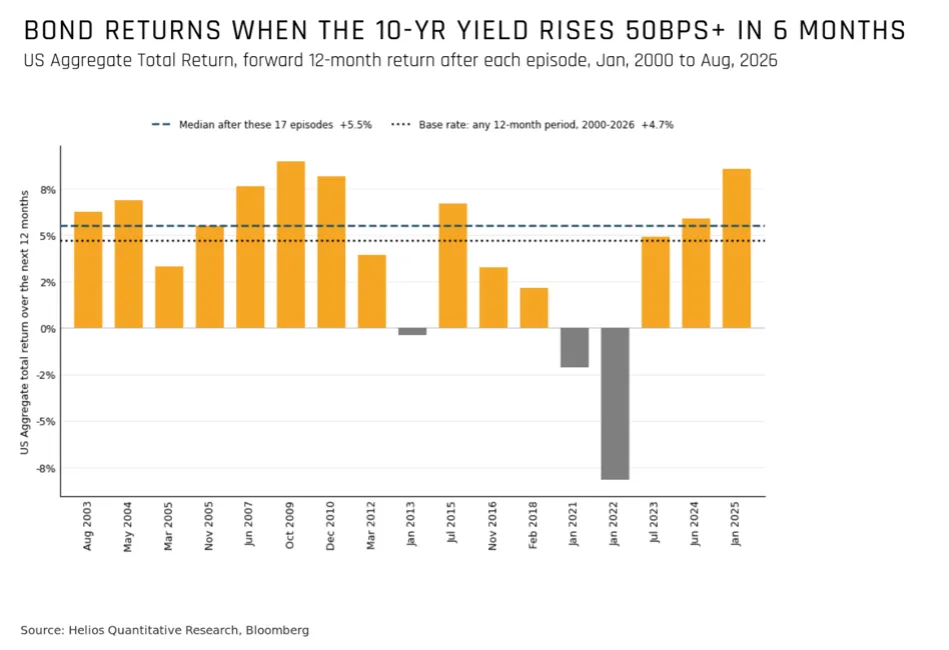
The chart reinforces that rising rates alone have not historically been a reason to abandon fixed income. Although bond prices can experience short-term volatility when yields move higher, today’s elevated starting yields provide more income and a greater cushion against future price declines. This makes fixed income an increasingly valuable source of portfolio income, diversification, and stability, particularly if economic growth slows further or the Federal Reserve eventually begins reducing rates.
Taken together, the current environment remains one of cautious optimism rather than strong conviction. The economy is soft, but conditions have remained good enough to support continued expansion. Corporate profits are holding up, market participation remains constructive, and higher bond yields have created more attractive opportunities within fixed income. At the same time, uncertainty surrounding employment, inflation, and Federal Reserve policy supports maintaining a patient and disciplined approach. For now, remaining invested, emphasizing quality and diversification, and allowing the data to provide greater clarity appear more appropriate than making significant portfolio changes based on any single economic report or market headline.
DISCLOSURE
This update is not intended to be relied upon as forecast, research, or investment advice, and is not a recommendation, offer, or solicitation to buy or sell any securities or to adopt any investment opinions expressed are as of the date noted and may change as subsequent conditions vary. The information and opinions contained in this letter are derived from proprietary and nonproprietary sources deemed by Hilltop Wealth & Tax Solutions (“Hilltop Wealth”) to be reliable. The letter may contain “forward-looking” information that is not purely historical in nature. Such information may include, among other things, projections, and forecasts. There is no guarantee that any forecast made will materialize. Additional information about Hilltop Wealth is available in its current disclosure documents, Form ADV, Form ADV Part 2A Brochure, and Client Relationship Summary Report, which are accessible online via the SEC’s Investment Adviser Public Disclosure (IAPD) database at www.adviserinfo.sec.gov/firm/summary/290981. Hilltop Wealth is not an attorney, and no portion of this content should be interpreted as legal advice. Hilltop Wealth may refer clients to its tax division for tax preparation and/or bookkeeping services. Services will be separately agreed upon between the client and the tax division and bill the client separately for services.