


MARKET OVERVIEW
A powerful earnings season and receding market fear drove equities to fresh record highs in the second half of April, even as the U.S.-Iran conflict continued to roil energy markets and complicate the Federal Reserve’s path forward. Two forces competed for dominance: AI-driven corporate strength on one side, and an unresolved oil supply shock on the other. Investors sided with fundamentals, betting that the conflict’s economic damage would prove manageable, and that diplomacy would eventually restore oil flows through the Strait of Hormuz. The result was a broad, conviction-driven rally that erased the geopolitical discount built up in March and carried major indexes to new all-time highs.
First-quarter earnings proved stronger than expected, with 84% of S&P 500 companies topping estimates and blended growth tracking at 15.1%, a sixth consecutive quarter of double-digit expansion. Technology led the advance, powered by continued strength in AI, cloud computing, and digital infrastructure. Mega-cap reports reinforced that momentum, with Alphabet, Microsoft, Meta, and Amazon all delivering results that exceeded expectations and helped validate investor confidence in the AI-led growth cycle. Encouragingly, earnings strength was not confined to technology, as select industrial and cyclical companies also posted solid results and upbeat outlooks, suggesting the expansion retained some breadth despite macro uncertainty.
The Consumer Price Index (CPI) for March rose 0.9%, pushing annual inflation to 3.3%, its highest level since May 2024. Gas prices drove nearly three quarters of the increase, surging 21.2%, while core CPI, which excludes food and energy, rose a more contained 0.2% for the month and 2.6% year over year, slightly below forecasts and suggesting underlying price pressures remained relatively stable. Against that backdrop, the Federal Reserve left rates unchanged at Chair Powell’s final meeting, signaling patience as markets priced in no rate changes through year-end. First-quarter GDP came in at a 2.0% annualized rate, below expectations but a meaningful acceleration from the fourth quarter’s 0.5%, supported by an 8.7% increase in business investment tied partly to AI-related spending. Together, the data pointed to an economy still expanding despite an energy-driven inflation shock, leaving the rally dependent on whether price pressures fade before they begin to weigh on spending and investment.
ADVISOR PERSPECTIVE
Heading into May, markets are supported primarily by resilient corporate earnings, even as the broader economic backdrop becomes more challenging. Companies are still largely meeting expectations, but economic data has continued to soften, consumer-facing indicators remain under pressure, and geopolitical risks persist without clear resolution. The result is an environment where markets are relying more heavily on earnings and policy stability rather than broad-based economic strength. Rather than a period that rewards stretching for excess return, the current setup calls for a more measured approach. Policy remains the key variable shaping where markets can go from here, and with uncertainty still elevated, the emphasis shifts toward staying grounded in the data, focusing on quality, and balancing participation in opportunity with the need to protect capital.
Recent corporate earnings results have reinforced the strength of the current cycle, with profits beating expectations and double-digit earnings growth extending into a sixth consecutive quarter. Importantly, revenue growth has also held up, suggesting that performance is being driven by resilient demand rather than solely by cost-cutting or margin expansion. Leadership remains concentrated in technology, financials, industrials, and AI-related areas, but there are signs that the earnings story is broadening. Strong upside surprises in Communication Services and Consumer Discretionary sectors point to improving participation across the market, which helps reinforce the durability of the expansion.
Economic data in April reflected a more pressured backdrop, particularly across consumer-facing segments. Signs of weakness persisted, with employment conditions continuing to deteriorate, broader economic conditions declining further, and production falling to its weakest level in recent months. While consumer sentiment ticked up modestly in April, it remains near historic lows, underscoring the cautious tone among households. Sales showed only marginal improvement, offering limited relief on the demand side and reinforcing the view that consumer momentum has softened.
Looking ahead, forward-looking indicators have also begun to lose some traction. Measures of global output and leading indicators pulled back from recent highs, suggesting that the pace of growth may be moderating. However, the picture is not uniformly weak. Orders have held relatively steady, and services conditions improved notably during the month, helping to partially offset softness elsewhere in the economy. Taken together, the data reflects an economy facing meaningful near-term pressure, with broad-based softness in consumer and labor indicators tempering what remains a still supportive, if gradually fading, forward-looking signal.
Geopolitical risk has remained an important variable, but market behavior suggests it has not fundamentally altered the broader investment backdrop. Despite continued escalation, both equity volatility (as measured by the VIX) and bond market volatility (MOVE Index) have remained relatively range-bound and well below the spikes typically associated with systemic stress events.
Market reactions have been largely headline-driven and short-lived. Each flare-up in the Middle East has led to a temporary increase in volatility, but those moves have consistently faded, with volatility reverting toward its year-to-date baseline. This pattern suggests that investors are responding tactically to developments without materially reassessing the underlying macro-outlook, reinforcing the idea that geopolitical risk is being absorbed rather than repriced.
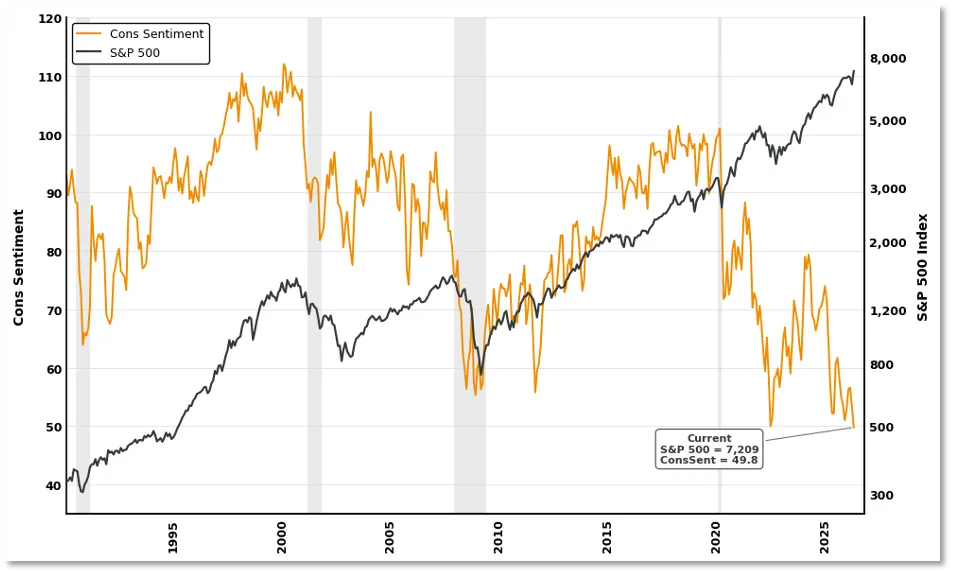
This dynamic is consistent with what we are seeing in the relationship between market performance and investor sentiment. Over the past 36 years, consumer sentiment and the S&P 500 have generally moved within a recognizable range, reflecting a broad alignment between how households feel and how markets are priced. However, that relationship has broken down meaningfully in the post-2020 period. Equities have continued to compound to new highs, while sentiment has fallen to a generational low. No prior period in the past three and a half decades has shown both indicators at opposite extremes simultaneously, suggesting that the traditional connection between sentiment and market performance has weakened materially.
Importantly, history has shown that low-sentiment environments have tended to be rewarded rather than punished. Prior troughs in 1990, 2008–09, and 2022 each preceded multi-year equity rallies, reinforcing the idea that sentiment is not a reliable market signal. In the current environment, this disconnect may be less a warning sign and more a reflection of broader uncertainty that markets have already worked through.
Taken together, the current environment points to a market that is increasingly reliant on execution and stability across multiple fronts. Strong earnings and resilient demand continue to provide a solid foundation, but softer economic data, persistent geopolitical uncertainty, and a more discerning investor base leave the path forward less certain. In that context, maintaining exposure while emphasizing quality and adaptability appears increasingly important, as markets continue to navigate the transition from broad-based momentum to a more selective and differentiated phase.
This update is not intended to be relied upon as forecast, research, or investment advice, and is not a recommendation, offer, or solicitation to buy or sell any securities or to adopt any investment opinions expressed are as of the date noted and may change as subsequent conditions vary. The information and opinions contained in this letter are derived from proprietary and nonproprietary sources deemed by Hilltop Wealth & Tax Solutions to be reliable. The letter may contain “forward-looking” information that is not purely historical in nature. Such information may include, among other things, projections and forecasts. There is no guarantee that any forecast made will materialize. Additional information about Hilltop Wealth Solutions is available in its current disclosure documents, Form ADV, Form ADV Part 2A Brochure, and Client Relationship Summary Report, which are accessible online via the SEC’s Investment Adviser Public Disclosure (IAPD) database at www.adviserinfo.sec.gov, using SEC # 801-115255. Hilltop Wealth Solutions is neither an attorney nor an accountant, and no portion of this content should be interpreted as legal, accounting, or tax advice.