


MARKET OVERVIEW
Markets spent the second half of July adjusting to forces pulling in opposite directions. The artificial intelligence trade that powered indexes through the first half of the year came under pressure, prompting investors to rotate into areas that had previously lagged. The Federal Reserve held rates steady, but an unusually divided vote raised questions about the central bank’s commitment to containing inflation. Renewed fighting between the United States and Iran near the Strait of Hormuz added another source of uncertainty by threatening global energy supplies. Major indexes finished with little changed, masking significant movement beneath the surface.
That rotation defined the period. Semiconductors bore the brunt of the decline, with the Philadelphia Semiconductor Index falling roughly 24% from its late-June high as investors became less willing to reward ambitious spending plans without clearer evidence of returns. The Nasdaq Composite briefly fell more than 10% below its record, but capital largely shifted within the market rather than leaving it altogether. Health care and financials climbed to record highs, while the equal-weighted S&P 500 reached a new high on July 28, signaling broader participation rather than a breakdown in investor confidence. Volatility remained relatively contained, and strong capital-spending plans from the largest cloud providers helped technology stabilize toward month-end.
Monetary policy and economic data gave both sides of the market debate something to consider. The Fed held its benchmark rate at 3.50% to 3.75% on July 29, marking a fifth consecutive hold, though three regional Fed presidents dissented in favor of a quarter-point increase. Treasury yields rose sharply, with the 10-year yield topping 4.7% and the 30-year reaching 5.25%. Meanwhile, inflation-adjusted gross domestic product expanded at a weaker-than-expected 1.5% annualized rate in the second quarter. Inflation offered a more encouraging signal, as the Personal Consumption Expenditures (PCE) price index declined 0.1% in June and slowed to 3.7% year over year. However, Brent crude settled above $90 following strikes on tankers transiting the Strait of Hormuz, raising the risk that higher energy costs could complicate the inflation outlook.
The bottom line: July’s relatively calm index performance obscured a meaningful shift in market leadership. Participation broadened beyond the year’s dominant technology trades, but slower growth, rising Treasury yields, cooling measured inflation, and higher oil prices left the economic and Federal Reserve policy outlook unusually uncertain heading into the fall.
Advisor Perspective
July’s nearly unchanged headline index returns did not fully reflect the meaningful shifts taking place within the market. Rather than signaling a broad deterioration in investor confidence, the month reflected a rotation in market leadership as investors became more selective following the technology-driven rally of the first half. Financial stocks reached new highs, while health care emerged as a market leader. At the same time, the equal-weighted S&P 500 advanced to a record, indicating that capital was rotating within equities rather than leaving the market altogether.
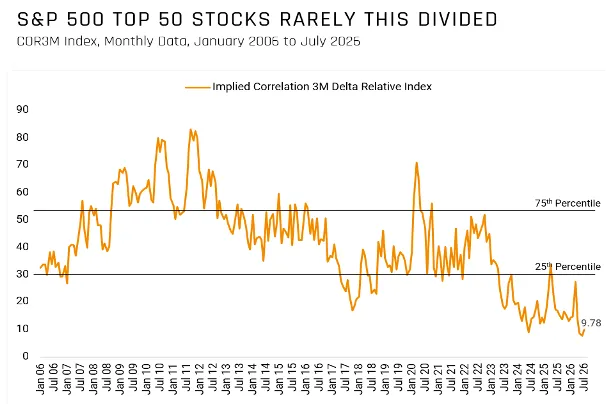
That broadening is especially important because the largest stocks are currently behaving very differently from one another. Options markets suggest that the expected average correlation among the S&P 500’s largest 50 stocks has fallen below 10, compared with a long-term average of roughly 42. Lower readings indicate that these stocks are expected to move more independently of one another, rather than rising and falling in unison. In practical terms, the companies that represent close to 60% of the index are no longer moving as a solitary group. Weaknesses in one large company are increasingly being offset by strength elsewhere, helping keep the broader index stable even as individual stocks experience significant volatility.
Artificial intelligence remains one of the market’s most important long-term investment themes, but July demonstrated that leadership within the space will not move in a straight line. Following an exceptionally strong first half of the year, investors became less willing to reward ambitious spending plans without clearer evidence that those investments would translate into sustainable revenue and earnings growth. The resulting momentum reversal was unusually sharp, with many of the technology and AI-related companies that had previously led the market experiencing significant declines. However, the broader market remained comparatively stable, suggesting that July represented a concentrated rotation away from previous leaders rather than a breakdown across equities as a whole.
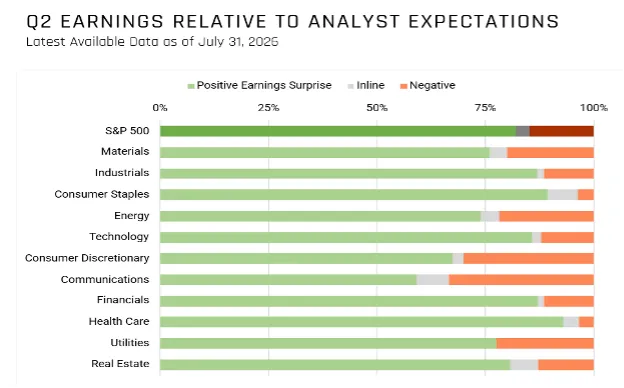
Corporate earnings continue to provide meaningful support for the broader market. With approximately 61% of S&P 500 companies having reported second-quarter results through July 31, 86.6% exceeded earnings expectations and 68.2% surpassed sales estimates. Although the aggregate earnings surprise was influenced by unusually strong results in a few areas, earnings strength extended across Health Care, Technology, and Financial sectors. Sales surprises were also positive across nearly every sector, providing a more durable indication that business demand remains resilient. These results reinforce the view that the market’s foundation extends beyond artificial intelligence and that a broader group of companies continues to benefit from steady economic activity.
The economic backdrop remains supportive enough to sustain the expansion, although conditions have become more uneven. Second-quarter real gross domestic product increased at a weaker-than-expected 1.5% annualized rate, but consumer spending and private investment continued to contribute positively to growth. Business investment also expanded beyond AI infrastructure into industrial and transportation equipment, supporting activity across both technology and economically sensitive industries. At the same time, lower household savings, slower income growth, and higher gasoline prices could place additional pressure on consumer activity later in the year. The current environment is therefore better characterized as slower but resilient growth rather than the beginning of a broad economic contraction.
Federal Reserve policy remains one of the primary sources of uncertainty. The central bank held its benchmark rate at 3.50% to 3.75% in July, but three dissenting votes in favor of an increase reflected continued concern that inflation may remain above target. Longer-term Treasury yields moved higher following the decision, increasing pressure on rate-sensitive assets and equity valuations. At the same time, recent inflation data offered evidence that measured inflation continues to cool. These competing signals leave the Federal Reserve balancing persistent inflation risks against slower economic growth, making markets increasingly sensitive to each new employment, inflation, and consumer-spending report.
As August begins, the investment environment remains policy-driven, but the broader foundation supporting markets is still constructive. Corporate earnings have remained resilient, economic activity continues to expand, and market leadership has broadened beyond the narrow group of technology companies that dominated earlier returns. Periods of volatility should be expected as investors assess inflation, interest rates, and geopolitical developments, but July’s rotation reinforces the value of maintaining exposure across multiple sectors, styles, and sources of return. Rather than reacting to each change in leadership, a disciplined and diversified investment approach remains the strongest foundation for participating in long-term opportunities while managing risk through an evolving market environment.
DISCLOSURE
This update is not intended to be relied upon as forecast, research, or investment advice, and is not a recommendation, offer, or solicitation to buy or sell any securities or to adopt any investment opinions expressed are as of the date noted and may change as subsequent conditions vary. The information and opinions contained in this letter are derived from proprietary and nonproprietary sources deemed by Hilltop Wealth & Tax Solutions to be reliable. The letter may contain “forward-looking” information that is not purely historical in nature. Such information may include, among other things, projections, and forecasts. There is no guarantee that any forecast made will materialize. Additional information about Hilltop Wealth & Tax Solutions is available in its current disclosure documents, Form ADV, Form ADV Part 2A Brochure, and Client Relationship Summary Report which are accessible online via the SEC’s Investment Adviser Public Disclosure (IAPD) database at www.adviserinfo.sec.gov, using SEC # 801-115255. Hilltop Wealth & Tax Solutions is neither an attorney nor an accountant, and no portion of this content should be interpreted as legal, accounting, or tax advice.